
Search Engine Optimization has never been a set-it-and-forget-it part of building a website, but over the last few years we have seen a major shift in the field which is, of course, centered around Artificial Intelligence. As creatives, we aren’t necessarily fans of the way generative AI has been forced into every step of our workflow, but we are interested in what it means for our clients and their websites. As search becomes more and more shaped by AI, understanding how websites need to be built for these new systems has become a key part of the value we provide to our clients as a web design agency, so in this doc we are sharing a bit about what we do and how we do it.
Our goal is to help you understand the concepts and techniques that we employ so that you can either learn how to employ them yourself, or understand the complexity of what is required to grow your website in 2026 and how Blue Dot Creative can help.
For many years, small businesses could get surprisingly far with the basics of SEO. Keywords, good copywriting, and image alt-text gave search engines just enough content to provide decent results. These basics still matter, but modern search rewards a well-structured and machine-readable website in a way that you can’t afford to miss out on.
What is the difference between SEO & GEO?
Search Engine Optimization: Helps search engines such as Google or Bing discover, understand, and rank your website.
Generative Engine Optimization: Improves how clearly your business and content can be understood, referenced, and surfaced by generative AI/search experiences.
Good web strategy has always been done with both the search engine and the website visitor in mind, in fact it’s like playing a game of telephone where your website tells the search engine who you are, what you do, and what your content is all about. The search engine then relays that information to your audience when someone searches for it.
Before:

Today, there is another player in that game of telephone. AI-powered search and generative tools can also interpret and pull information from your website. That means that your website now needs to communicate clearly with your users, search engines, and AI systems.
Now:
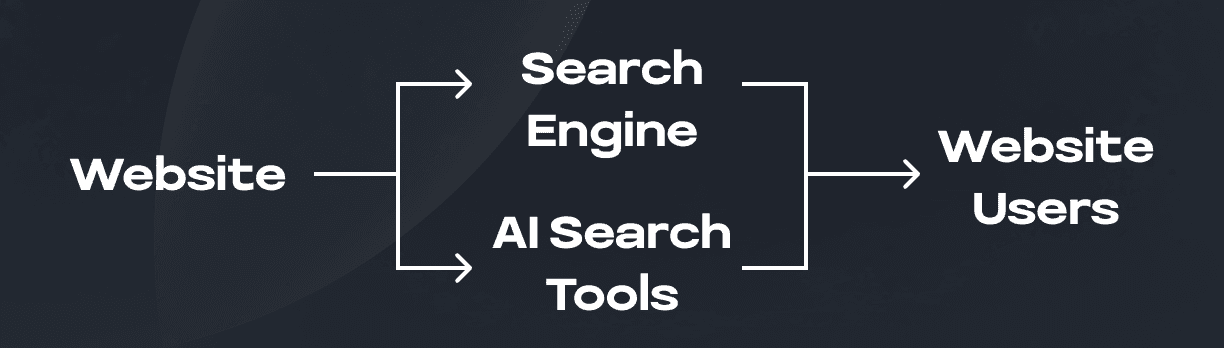
Communicating with your users: Clear messaging, intuitive navigation, useful content, accessibility, compelling design, fast performance, and clear calls to action.
Communicating with the Search Engine: Keyword relevance, page titles and meta descriptions, heading hierarchy, crawlability and indexability, internal linking, descriptive URLs, image alt text, technical performance, backlinks, and structured data/schema markup.
Communicating with AI Tools: Clear and contextual content, semantic structure, entity information, structured data/schema markup, direct answers to relevant questions, consistent business information, authoritative supporting content, and clearly defined relationships between the people, organizations, services, locations, and topics involved.
That's a lot of technical terminology, and even knowing what these things are is different from knowing how to implement them correctly. The good news is that you don't need to become an SEO expert to start identifying where your website may be falling short.
Can you tell what every page is about from its primary header (H1)?
Does every important page have a unique title and meta description?
Does each page have a unique Schema Markup?
Can Google index your key pages?
Do your images have alt text that describes the image for accessibility purposes AND includes key wording for SEO purposes?
Does your site have a logical heading hierarchy?
Are related pages internally linked?
Can search engines clearly determine who your business/organization is, what it does and where it operates?
Is that business information consistent across the web? (your website, social media pages, Google MyBusiness profile, etc.)
Does your content answer the questions customers actually search for?
Run your website through Google's PageSpeed Insights to help identify specific SEO and performance issues that could be harming your site:

Your website is working well but SEO/GEO needs some attention:
You can most likely fix these issues on your own with a little help from the internet. We would be happy to assist, but you probably do not need professional help yet.
You're in a constant fight with your website:
If you’re are in a constant fight with your website then there might be deeper issues that need to be identified and fixed. This could look like restructuring your site, extensively reworking the SEO strategy or even a complete website overhaul…
We offer free Website Audits and SEO Strategy Reviews to help you identify where your website is falling short and to explore how we can help.
Just fill out our Website Audit Inquiry Form below and we will provide you with actionable insights within a few business days: